- Cable Wire Recycling Machines and Metal Processing Systems
- AC Condenser Recycling Machine
- Radiator Copper Aluminium Separator Machine for Scrap Metal Recycling
- ACSR Cable Recycling Machine for Aluminum and Steel Separation
- Hydraulic Metal Briquetting Machine for Metal Chip Recycling
- Electric Motor Recycling Machine for Copper and Iron Recovery
- Industrial Copper Wire Granulator for Waste Cable Recycling
- cost of hydraulic briquetting machine for waste recycling
Cable Wire Recycling Machines and Metal Processing Systems
Cable recycling equipment and metal processing systems separate the copper and aluminum conductors from the plastic or rubber insulation layers of waste wires and cables through pre-crushing, fine crushing, screening, and sorting. This is suitable for the resource recovery of waste cables, automotive wiring harnesses, communication lines, and industrial wires. Equipment configuration needs to be determined based on the raw material specifications and processing volume.
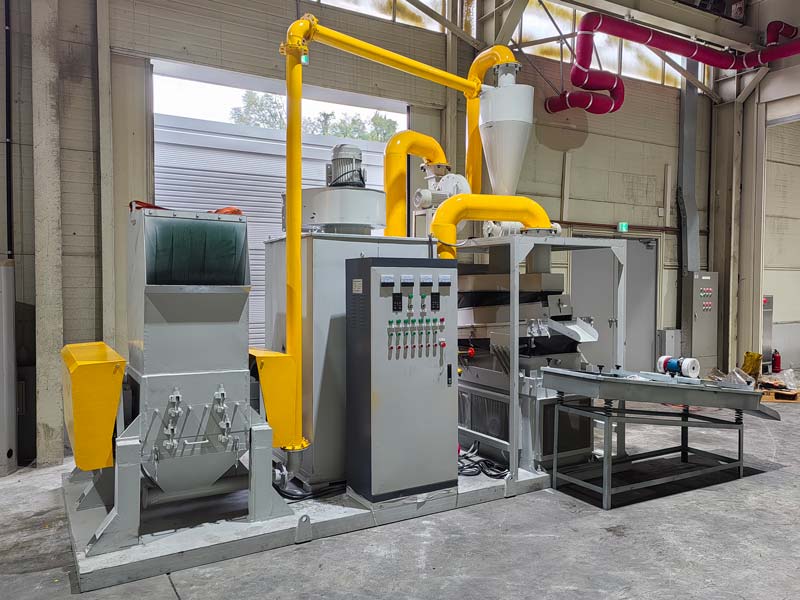
A complete Cable Wire Recycling System typically consists of a twin-shaft shredder, a copper wire granulator, an air classifier, a vibrating screen, and a dust removal system. For cables containing steel armor or ferrous impurities, a magnetic separator can be added to remove ferromagnetic materials in advance, reducing subsequent blade wear and the introduction of metallic impurities.
The twin-shaft shredder is responsible for shearing large cables into smaller segments, improving feed stability; the copper wire granulator further shreds the material, ensuring complete separation of the conductor and insulation layer. The granulation particle size directly affects the sorting effect; some production lines use particles of approximately 2–5 mm as the sorting target. The specific size should be adjusted based on the cable diameter, conductor structure, and equipment design.

Cable Wire Recycling Machines and Metal Processing Systems
The finely shredded mixture typically first enters an air classifier for initial separation, utilizing the density and aerodynamic differences between copper, aluminum, and plastic. For materials still containing fine copper wires or mixed particles, electrostatic separation equipment can be added to further purify them using the differences in conductivity between metals and non-metals.
The dust removal system is also a crucial component of the production line. Plastic scraps and fine powder are generated during shredding and granulation, requiring collection via dust hoods, ducts, cyclone separators, or pulse jet dust collectors. Proper airflow design not only affects the working environment but also the stability of conveying and sorting lightweight plastics.
It is important to note that copper wire recovery rate does not equate to copper product purity. Equipment evaluation should separately test metal recovery rate, copper or aluminum product purity, and the proportion of residual metals in the plastic, avoiding judgment of equipment performance based on a single indicator.
The processing capacity of cable recycling equipment should be determined based on the actual feed volume. For example, some standard models have a rated capacity of 100–300 kg/h, while industrial production lines are available with capacities of 500–1000 kg/h and higher. The figures above are for illustrative purposes only and do not represent the same output for all cables; armored cables, fine wires, mixed harnesses, and high-impurity materials may require different configurations.
When selecting equipment, cable diameter, copper-to-aluminum ratio, insulation type, armor condition, and target hourly throughput should be provided. Voltage, installation space, tooling maintenance, and dust collection requirements should also be confirmed. For recycling companies with significant variations in raw materials, modular equipment combinations are generally easier to adjust later than simply pursuing a larger granulator.
Properly matching crushing, granulation, sorting, and dust removal equipment is essential to establishing a stable cable recycling process and improving the quality of copper, aluminum, and insulation material recycling.

INQUIRY