- Cable Wire Recycling Machines and Metal Processing Systems
- AC Condenser Recycling Machine
- Radiator Copper Aluminium Separator Machine for Scrap Metal Recycling
- ACSR Cable Recycling Machine for Aluminum and Steel Separation
- Hydraulic Metal Briquetting Machine for Metal Chip Recycling
- Electric Motor Recycling Machine for Copper and Iron Recovery
- Industrial Copper Wire Granulator for Waste Cable Recycling
- cost of hydraulic briquetting machine for waste recycling
ACSR Cable Recycling Machine for Aluminum and Steel Separation
P>ACSR (Aluminum Conductor Steel Reinforced) cables consist of an outer layer of aluminum stranded wire and an inner steel core, and are commonly used in power transmission lines. Because aluminum and steel are tightly bonded, ordinary wire stripping machines or simple shredding equipment are not suitable for direct processing; therefore, cutting and separating equipment specifically designed for their structure is required.
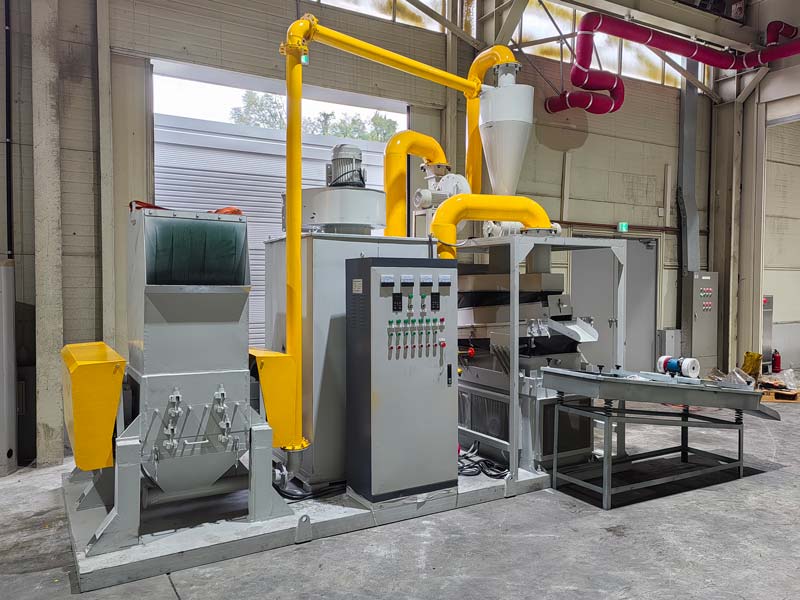
The core function of the ACSR Cable Recycling Separator is to cut long cables and separate them using the differences in the physical properties of aluminum and steel. After processing, the equipment can separate aluminum and steel materials, facilitating subsequent sales or further processing.
The equipment’s workflow is relatively straightforward: waste ACSR cables first enter an automatic feeding system, where they are cut by a cutting roller, processing continuous long cables into shorter pieces. Depending on the equipment configuration, the cutting length can be set to approximately 10 mm, 20 mm, or 50 mm to facilitate subsequent separation. Some models employ a three-speed drive design, allowing adjustment of the operating speed according to the raw material specifications.

ACSR Cable Recycling Machine for Aluminum and Steel Separation
The cut aluminum and steel mixture then enters a magnetic separation system. Because steel cores are magnetic, while aluminum is largely unaffected by magnetic fields, magnetic separators can attract and transport steel to a separate outlet, while non-magnetic aluminum is discharged through another channel.
Taking publicly available equipment parameters as an example, an ACSR recycling machine has an inlet of approximately 200 mm, suitable for simultaneous feeding of multiple cable strands, a maximum processing speed of 50 m/min, and a power configuration of approximately 18.5 kW + 3 kW + 0.75 kW. Some manufacturers claim a separation rate of up to 99%, but the actual effect is still affected by cable specifications, cutting size, feeding speed, and equipment debugging.
For ACSR Cable Recycling Machines, processing speed alone is insufficient; attention should also be paid to the raw material diameter, steel core structure, feeding method, cutting size, and final aluminum purity.
If primarily processing large quantities of long cables generated from dismantling power lines, continuous feeding and multi-strand feeding capabilities should be prioritized; if the raw material specifications vary significantly, the strength of the cutting tools, the transmission system, and the adjustable range of the cutting size are crucial factors. In publicly available case studies, some equipment utilizes magnetic tape sorting to automatically transport the steel core to a separate outlet, thereby reducing manual sorting.
Therefore, ACSR recycling is not simply about “shredding the cable,” but rather about striking a balance between cutting size and separation methods. Proper pretreatment can reduce the difficulty of subsequent sorting and minimize losses caused by the mixing of aluminum and steel.
For recycling companies that need to process waste ACSR cables, transmission line replacement waste, or large quantities of steel-cored aluminum stranded wire, appropriate cutting and aluminum-steel separation equipment can be configured based on the raw material specifications and production volume.

INQUIRY